


The Russet Potato
By Adam Calder, Wheatsfield Produce Manager
The Russet potato, our 9th top-selling item in the produce department, seems ordinary enough. This is what many people conjure in their mind’s eye when they think “potato.” As it turns out, this American classic has a fascinating history that easily could have never happened.
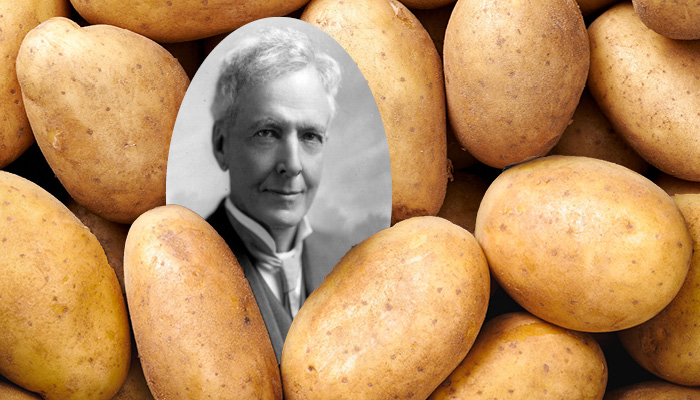
The year was 1872, in Lunenburg, Massachusetts, and a plant breeder named Luther Burbank was walking through a patch of Early Rose potatoes, a popular New England potato. Burbank noticed something one does not usually see on a potato: a maturing seed-ball. Potatoes usually propagate from their underground tubers, but will very rarely make an above-ground fruit that looks like a tiny tomato.
This is what Burbank saw, and he marked the plant so he could keep an eye on it. One day, he noticed his prized seed-ball was no longer on the plant. He spent days scrutinizing the surface of the soil in the potato patch on his hands and knees, until he found and retrieved the seed-ball. There were twenty-three seeds inside.
Burbank saved them all, and planted them the following spring. Every seed sprouted, and each plant was unique. Tiny Tubers, large ones, and all the sizes between. A variety of colors, shapes, and textures. Some plants yielded few tubers, but some grew many. Of these twenty-three plants, two produced distinctly large potatoes with shallow eyes. Burbank saved these potatoes all winter, and noted that they stored well. He planted them in the spring, and of the two varieties, one had a much larger yield, and also coincidentally happened to be resistant to the late blight that had recently devastated Ireland. Burbank knew he had stumbled onto something valuable, and he named this the Burbank Russet Potato.
With shallow eyes and a consistently large oval size, these new potatoes were easier to peel than most potatoes on the market. This plant readily grew huge (two to three pound) potatoes, producing a large yield from small plots of land. Its starchy white flesh had just the right amount of moisture in it to bake and mash up fluffy, and also fry up crispy without over-browning. Russets are also high in protein, minerals, and vitamins, and low in fat/cholesterol. They have a pleasant, nutty flavor that was immediately popular when it hit the market.
In 1875, Burbank sold the rights to grow his potato to James J. H. Gregory, the owner of a seed-selling company. Burbank used this money to move to a farm in California to continue his lifelong plant breeding passion. He grew his potato on the west coast, Gregory grew Burbank Russets on the east coast, and soon, so did all the states in between. Today they are grown the world over, and it all came from one tiny seed-ball that could have easily been overlooked.









Who knew?! What a great story, thank you.